Saturday, September 09, 2006
Chilean cinema verite
From the Associated Press: "Sixteen years after the end of Gen. Augusto Pinochet's dictatorship, emboldened Chilean filmmakers are shrugging off the cloak of silence to release documentaries detailing hidden stories of his reign's dark years." Well, it's about time.


Breaking news: Michael Moore pisses off some people
What you must remember, however, is that some people deserve to be pissed off.
'The Path to 9/11' is paved with dubious intentions
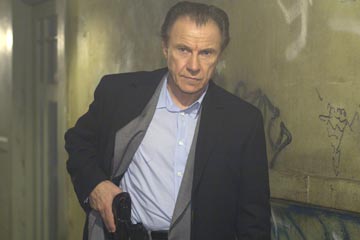 Tom Shales nails ABC's controversial The Path to 9/11 as being, quite simply, not worthy of its subject: "The docudrama -- allegedly produced as a warning to the United States that the attacks, or something like them, could happen again -- falls clumsily into traps that await all those who make fictional films claiming to be factual. Except this time, the event being dramatized is one of the most tragic and monstrous in the nation's history, not something to be trifled with."
In the Los Angeles Times, Tim Rutten surveys "the smoking ruin that is ABC's reputation after the Path to 9/11 debacle," and pronounces that the "lacerating controversy surrounding the network's docu-dramatic re-creation of events leading to Sept. 11 is an entirely self-inflicted wound." At the same time, however, Rutten rightly questions whether censorious Democratic leaders in the U.S. Senate are guilty of "a stunning affront to 1st Amendment freedoms."
Some critics are praising Harvey Keitel's performance as FBI counter-terrorism expert John O'Neill, whose efforts to contain the al-Qaida threat were rebuffed repeatedly by those above him. (An irony no scriptwriter would dare invent: Two weeks after he retired at age 49 to become director of security for the World Trade Center, O'Neill was among the unfortunates killed when the planes hit the Twin Towers.) It should be noted, however, that even Keitel isn't happy about the way the docudrama turned out.
Meanwhile, Doug Elfman indicates that, inaccuracies aside, there's another reason to dis The Path to 9/11 -- the docudrama sucks.
Blah b.o.
Nikki Finke has the early word on weekend box-office estimates. Looks like, once again, a teen-skewing horror movie that wasn't screened for critics will claim the No. 1 spot.
Friday, September 08, 2006
Holy docudrama!
The ongoing controversy over ABC's Path to 9/11 docudrama just got a lot more interesting. And, for ABC, a great deal more embarrassing.
Thursday, September 07, 2006
Linkage: 'Truth,' goof and 'Sleuth'
The improbably popular An Inconvenient Truth -- Al Gore's surprisingly fascinating and compelling eco-conscious documentary -- will be released Nov. 21 in what's being described as "earth-friendly" packaging. Well, of course.
Meanwhile, over at FishBowlLA, an indelicate question is raised: Why did Fox decide to dump Mike Judge's Idiocracy?
And what's all this, then? Jude Law starring in another remake of a Michael Caine movie? Actually, Caine himself also is slated to appear in the new version of Sleuth, playing the flamboyant mystery writer memorably essayed by Laurence Olivier in the 1972 original. Law will take over the character originally portrayed by Caine, a hunky hairdresser who has designs on the writer's wife. Kenneth Branagh will handle the directing chores for the remake -- which, like the '72 version (directed by Joseph Mankiewicz) -- is based on the ingeniously plotted play by the late Anthony Shaffer (whose 1973 screenplay for The Wicker Man recently was recycled, with unfortunate results, as a Nicolas Cage vehicle). All of which raises another indelicate question: How can the remake possibly hope to score the same impact as the '72 movie? In this Internet era of spoiler-filled blogs and fansites, it will be almost impossible to keep the play's (and the original film's) jaw-dropping plot twist a secret from the uninitiated until the remake hits megaplexes.
Meanwhile, over at FishBowlLA, an indelicate question is raised: Why did Fox decide to dump Mike Judge's Idiocracy?
And what's all this, then? Jude Law starring in another remake of a Michael Caine movie? Actually, Caine himself also is slated to appear in the new version of Sleuth, playing the flamboyant mystery writer memorably essayed by Laurence Olivier in the 1972 original. Law will take over the character originally portrayed by Caine, a hunky hairdresser who has designs on the writer's wife. Kenneth Branagh will handle the directing chores for the remake -- which, like the '72 version (directed by Joseph Mankiewicz) -- is based on the ingeniously plotted play by the late Anthony Shaffer (whose 1973 screenplay for The Wicker Man recently was recycled, with unfortunate results, as a Nicolas Cage vehicle). All of which raises another indelicate question: How can the remake possibly hope to score the same impact as the '72 movie? In this Internet era of spoiler-filled blogs and fansites, it will be almost impossible to keep the play's (and the original film's) jaw-dropping plot twist a secret from the uninitiated until the remake hits megaplexes.
Tuesday, September 05, 2006
Marxist theory
 Interesting piece by Alessandra Stanley in Wednesday's New York Times about Katie Couric's debut as the new CBS news anchor chair, and Rosie O'Donnell's addition to ABC's The View. But I have to ask myself: How many readers under the age of 50 will understand the (apt and amusing) allusion to Zeppo Marx?
Breaking news: Some people in showbiz have big egos
"Celebrities have more narcissistic personality traits than the general population, and people with narcissistic tendencies seem to be attracted to the entertainment industry rather than the industry creating narcissists, according to a groundbreaking study conducted by researchers Drew Pinsky of the Keck School of Medicine of USC and S. Mark Young of the USC Marshall School of Business and the USC Annenberg School for Communication."
Well, d'uh!
Well, d'uh!
'Fountain' tanks?
Over at Green Cine Daily, David Hudson has posted a report on the world premiere of The Fountain, Darren Aronofsky's long-awaited sci-fi fantasy, at the Venice Film Festival. The critics were not kind.
Monday, September 04, 2006
Hurt
Just a few days ago, I was interviewing country music superstar Trace Adkins for Cowboys & Indians magazine. And being the gent that he is, he agreed with me that Mark Romanek's video for Johnny Cash's rendition of the Nine Inch Nails song "Hurt" is -- well, one of the greatest music videos, in any muscial genre, of all time. So I have to say that it's a little disconcerting to hear from David Poland that Cash's recording is now being used for a Nike commercial in Europe.
What a glorious feeling!
 The American Film Institute officially proclaimed Sunday evening something most of us already knew: Singin' in the Rain is the greatest movie musical ever made.
Mind you, many of the other musicals on the AFI's all-time Top 25 list also can lay claim to being considered classics. (I'm especially happy to see Bob Fosse's audacious All That Jazz made the cut at No. 14.) But Singin' in the Rain is by far the best of the best. Why? Well, as I've noted in my Guide to Essential Movies, you can take your pick: (A) The virile grace, infectious enthusiasm and self-mocking good-sportsmanship of Gene Kelly; (B) the canny co-direction of Kelly and Stanley Donen, fortuitously teamed dance masters who warmed up with On the Town (No. 19 on the AFI list) before ensuring their immortality with this masterwork; (C) the splendiferous supporting performances of antic Donald O’Connor and endearing Debbie Reynolds; (D) the scintillating screenplay by Betty Comden and Adolph Green, which artfully commingles spoofery, sentiment and showbiz mythos; (E) the astute conceptualization of producer Arthur Freed, the brilliantly eclectic mastermind who supervised two decades’ worth of musical extravaganzas during the golden age of Metro-Goldwyn-Mayer; or (F) all of the above.
If you chose (F) -- give yourself an A-plus. Better still, count yourself among the savvy film aficionados who recognize Singin’ in the Rain as one of the more decisive exceptions to the auteur theory. A theory, it should be noted, that Stanley Donen himself has dismissed as simplistic. “Anyone who says that every picture is not a collaboration is an idiot,” he insisted in a late ’60s interview. “It’s a question of how much you collaborate, and who you collaborate with.”
In the case of Singin’ in the Rain, producer Freed – a former Vaudevillian who worked his way up from staff songwriter to Grand Kahuna of musical production at MGM – lays claim to the title of Most Valuable Collaborator. After all, it was Freed who assembled the other members of the creative dream team for this classic, and whose multifaceted showbiz experiences informed both the story and the storytelling.
Long before Baz Luhrmann ransacked a half-century of pop music history to collect the playlist for his razzle-dazzling Moulin Rouge (No. 25 on the AFI list), Freed commissioned a similar, smaller-scaled job of recycling: He directed Comden and Green to concoct a script that would incorporate several tunes Freed had written with composer Nacio Herb Brown for dozens of earlier MGM movies.
“Singin’ in the Rain,” the best of the lot, had been introduced in The Hollywood Revue of 1929, a patchwork of songs, sketches and dances that was hurriedly thrown together at MGM during the early, awkward days of talking pictures. How appropriate, then, that the tune would provide a title – and cinema’s grandest solo production number – for the smart and sassy Comden-Green scenario about the madcap misadventures that ensue as moviemakers make the transition from silents to talkies.
The fun begins at the Hollywood premiere of a silent swashbuckling epic, then segues to an extended flashback as superstar Don Lockwood (Kelly) gives a fawning interviewer a self-serving account of his salad days. Even as Don insists that he and best buddy Cosmo Brown (O’Connor) adhered to a simple motto – “Dignity, always dignity!” – the richly amusing montage shows how they barely made the grade as Vaudeville song-and-dance men (like Freed, perhaps?) until Don stumbled into movies as a stuntman, and Cosmo tagged along as an on-set musical accompanist.
Singin’ in the Rain maintains its puckishly playful tone as we’re introduced to Lina Lamont (the great Jean Hagen), Don’s frequent co-star and (according to the fan magazines, which Lina accepts as gospel) his off-screen love interest.
Lina looks like a fetching goddess – and sounds like a screeching harpy. Like many others in the Hollywood firmament, she runs the risk of becoming a fallen star as talking pictures become the rage. Fortunately, the producers of her first talkie are able to disguise her vocal deficiencies: They arrange for Lina’s singing and speaking to be dubbed by Kathy Seldon (Reynolds), an aspiring actress (and sometime chorus girl) who just happens to be the real off-screen apple of Don’s eye. When she learns of the deception, however, Lina vows to keep Kathy behind the scenes – and away from Don.
Singin’ in the Rain vividly conveys heady atmosphere of panic, promise and improvisation that prevailed in Hollywood at the dawn of the talkies, often alluding to real-life mishaps and missteps that have become the stuff of showbiz legend. (Note the hilarious struggles to camouflage microphones and record audible dialogue.) Indeed, this enduringly entertaining musical merits inclusion in the syllabus of any college-level film history course. But don’t let that scare you off: Donen, Kelly and company never allow facts to get in the way of telling a wonderfully entertaining story, and casting an irresistibly captivating spell.
Because of that, and so much more, Singin' in the Rain continues to shine more than a half-century after its initial theatrical release. Now and forever: This one's No. 1.
Gibson nailed by Hebrew Hammer?
Mel Gibson meets a grisly end in the opening scene of the script for a proposed sequel to The Hebrew Hammer. No, I'm not making that up. Hey, if they can bump off President Bush in a mockumentary, why not waste Mel in a Jewish-skewing action-comedy?
Sunday, September 03, 2006
Caine complains
 Michael Caine tells The Times of London that most contemporary Hollywood movies are "stunningly banal and formulaic." Which, of course, is true. But his criticism might carry just a teeny bit more weight if Sir Michael didn't refer to How to Eat Fried Worms as a horror movie. Or was that mistake made by the reporter interviewing him?
Can 007 save Hollywood?
 Or will it be a blue Christmas for the major studios? Josh Friedman of the Los Angeles Times takes a look at what it will take for the industry to enjoy "a full-scale box-office rebound."
Sunday viewing tip
Several years ago, a colleague at the now-defunct Houston Post wrote a story about movies that some people – celebrities, mostly – like to watch over and over and over again on videocassette. (Hey, I told you this was several years ago.) When he ran out of really well-known folks to interview, he collared me in the newsroom and asked: “What movie do you watch repeatedly?” And so I told him: “There’s something about Tender Mercies that deeply and profoundly affects me on so many levels that, yes, I’m addicted to watching it. Whenever I get depressed, I want to pop the tape into the VCR, and hear Robert Duvall say: ‘I don’t trust happiness. Never did, never will.’ God, I know exactly how he feels.”
Flash-forward a few weeks: I am at Houston’s Stages Theatre for the opening night performance of Talking Pictures, a play by the great Horton Foote, the Oscar-winning scriptwriter of Tender Mercies (and To Kill a Mockingbird). There’s a post-performance party, and I’m off in a corner, munching on fried chicken I obtained from the bountiful buffet, when I spot Foote – who I’ve met maybe once or twice before that evening – across a crowded room. I nod, give him a thumb’s up – the play actually was quite good, and deserves to be revived – and go back to eating. Much to my surprise, however, Foote cuts short a conversation he’s having with someone, walks across the crowded room, makes his way over to me and, without a hint of irony, says: “Oh, Joe, I’m so sorry you get depressed…”
Bless you, Mr. Foote. And thank you again for writing Tender Mercies, which can be seen Sunday evening on Turner Classic Movies. Masterfully directed by Bruce Beresford, this is a spare, subtle film that speaks in a quiet yet compelling voice about faith and despair, regret and redemption, lower depths and second chances, while considering the restorative potential of human and divine love. Duvall earned his own Academy Award for his heart-wrenching performance as Mac Sledge, a down-and-out country singer who’s redeemed by the love a good woman (Tess Harper), then pushed back to the brink by a devastating tragedy. If you can remain dry-eyed during his final scene here, you’re made of sterner stuff than me.
Flash-forward a few weeks: I am at Houston’s Stages Theatre for the opening night performance of Talking Pictures, a play by the great Horton Foote, the Oscar-winning scriptwriter of Tender Mercies (and To Kill a Mockingbird). There’s a post-performance party, and I’m off in a corner, munching on fried chicken I obtained from the bountiful buffet, when I spot Foote – who I’ve met maybe once or twice before that evening – across a crowded room. I nod, give him a thumb’s up – the play actually was quite good, and deserves to be revived – and go back to eating. Much to my surprise, however, Foote cuts short a conversation he’s having with someone, walks across the crowded room, makes his way over to me and, without a hint of irony, says: “Oh, Joe, I’m so sorry you get depressed…”
Bless you, Mr. Foote. And thank you again for writing Tender Mercies, which can be seen Sunday evening on Turner Classic Movies. Masterfully directed by Bruce Beresford, this is a spare, subtle film that speaks in a quiet yet compelling voice about faith and despair, regret and redemption, lower depths and second chances, while considering the restorative potential of human and divine love. Duvall earned his own Academy Award for his heart-wrenching performance as Mac Sledge, a down-and-out country singer who’s redeemed by the love a good woman (Tess Harper), then pushed back to the brink by a devastating tragedy. If you can remain dry-eyed during his final scene here, you’re made of sterner stuff than me.
Historical footnote
If you're of a certain age, you know exactly where you were on Nov. 22, 1963, when you heard that President John F. Kennedy had been shot. The last words JFK ever heard -- "Mr. President, you can't say Dallas doesn't love you!" -- were spoken by a woman who died Friday. The Associated Press reports that Nellie Connally, the former Texas first lady who was riding in President Kennedy's limousine when he was assassinated, was the last living person who had been part of that fateful Dallas drive. Some of you might ask: Is there a movie connection here? Well, she does have her very own credits page on Internet Movie Database....
Saturday, September 02, 2006
Tutto Fellini!
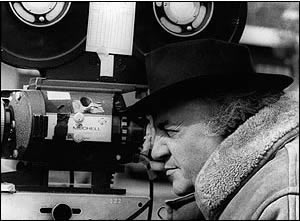 Should have posted this days ago, but better late than never: The Museum of Fine Arts, Houston is hosting a 22-film retrospective of Federico Fellini masterworks through Oct. 8. The series kicked off last night with La Strada, and runs the gamut from early classics (Nights of Cabiria, La Dolce Vita) to late obscurities (Intervista, The Voice of the Moon). And for the benefit of the uninitiated, Eric Harrison offers a "Fellini Made Easy" intro here.
Friday, September 01, 2006
Olbermann rules
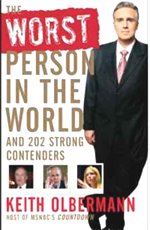 Set for release next week: The must-read book of the year, if not the decade. But who will star in the movie version of this budding best-seller? Well, you know, Jon Stewart really hasn't had a decent big-screen gig since Playing By Heart, so if they haven't cast the lead yet...
'Wicker' causes snickers
 It’s difficult to pinpoint the precise moment when Neil LaBute's remake of The Wicker Man completely jumps the tracks. For some, it will be the scene where Nicolas Cage, in dire need of transportation, turns a gun on a passing bicyclist and melodramatically commands: “Step. Away. From. The Bike." For others, it will be the fight scene that ends with Cage delivering a karate kick to a feisty Leelee Sobieski. (That that, bee-yotch!) But for most, the point of no return will arrive during an extended climactic sequence that calls for Cage to pad about in a tacky bear costume. It’s so hilarious, it’s almost, well, unbearable.
As I note in my Variety review: When a major studio release with two Oscar-winning stars (Cage and Ellen Burstyn) opens without press previews, one usually assumes the distributor is trying to hide the picture from critics. But in the case of Wicker Man, which wasn't screened until 10 pm Thursday here in Houston, it's entirely possible that Warner Bros. wanted to hide a ludicrous misfire – for as long as possible, at least – from audiences as well. Much funnier by accident than many intentional comedies, it’s bound to spark outbreaks of spontaneous laughter wherever it’s exposed to paying customers. Once derisive word of mouth starts to spread, only connoisseurs of high camp and curious devotees of disasters will be queuing up at the box-office.
After writing all that, and worse, and seeing it posted online, I was prepared for a dose of vitriolic sarcasm when I received an e-mail from LaBute this afternoon. Lo and behold, however, the note was a graciously polite missive in which the writer-director acknowledged my criticism with a philosophic shrug, and encouraged me to "keep up the good work."
But you know what? I've read this note again and again, and I still can't helping thinking of Aaron Eckhart in LaBute's In the Company of Men, and Jason Patric in his Your Friends and Neighbors -- charming fellows both, until they dropped their masks. Yeah, LaBute may be all grace and good manners now. But if I look out in my backyard tomorrow, and see a towering figure constructed from wicker, well....
Bush on film
Spike Lee couldn't resist dissing George Bush while promoting When the Levees Broke: A Requiem in Four Acts at the Venice Film Festival. And that, of course, should come as no surprise to anyone who has watched Lee's extraordinary documentary, which takes several well-aimed potshots at the Bush Administration's failure to provide speedy and sufficient aid to New Orleans in the wake of Hurricane Katrina.
Even so, it's questionable whether even the incorrigibly feisty Lee would make anything so incendiary as Death of a President, an audacious faux documentary set to screen this month at the Toronto Film Festival. The movie, according to the Toronto Sun, is fashioned as a future look back at the repercussions that follow President Bush's assassination in October 2007. Predictably, conservative commentators such as Rush Limbaugh already are attacking the film (without, it should be noted, bothering to actually see it).
On the other hand, another Bush-related project is receiving glowing advance praise from Limbaugh.
Even so, it's questionable whether even the incorrigibly feisty Lee would make anything so incendiary as Death of a President, an audacious faux documentary set to screen this month at the Toronto Film Festival. The movie, according to the Toronto Sun, is fashioned as a future look back at the repercussions that follow President Bush's assassination in October 2007. Predictably, conservative commentators such as Rush Limbaugh already are attacking the film (without, it should be noted, bothering to actually see it).
On the other hand, another Bush-related project is receiving glowing advance praise from Limbaugh.
Subscribe to:
Posts (Atom)